
August 4, 2025
Case study: Using Depixus MAGNA One™ to study interactions between the CRBN/DDB1 E3 ligase complex and its substrate MEIS2 produced in cell-free extracts
Based on magnetic force spectroscopy (MFS), Depixus MAGNA One™ is a user-friendly instrument system that allows real-time, label-free, non-destructive analysis of thousands of individual protein-protein interactions in parallel.
In this case study we show how Depixus MAGNA One provides single molecule insights into interactions between an E3 ligase complex and its substrate.
The detailed data about the nature and dynamics of protein-protein interactions provided by Depixus MAGNA One is highly valuable for the development of novel molecular glues and protein degraders.
What is CRBN/DDB1?
CRBN/DDB1 is a binary complex between Cereblon (CRBN) and Damaged DNA Binding Protein 1 (DDB1) and forms the core of the larger Cullin-RING (CRL4/CRBN) E3 ubiquitin ligase complex, which tags cellular proteins for destruction. One of its endogenous substrates is MEIS2 (Myeloid Ecotropic Insertion Site 2).
E3 ligases including the CRBN/DDB1 complex are valuable targets for an emerging class of drug known as molecular glue degraders – small molecules that induce or modulate interactions between a target protein and the cell’s degradation machinery.1
For example, IMiD molecular glues such as thalidomide or CC885 recruit the neo-substrate transcription factors IKZF1/3 (Ikaros/Aiolos) to CRBN/DDB1, resulting in their degradation.2
However, this interaction competes with recruitment of endogenous substrates such as MEIS2 so IMiDs simultaneously increase endogenous substrate levels while reducing the neo-substrates.
Using Depixus MAGNA One to study interactions between CRBN/DDB1 and MEIS2 with single molecule resolution
In these experiments, we produced CRBN/DDB1 and MEIS2 protein using the ALiCE cell-free expression system from LenioBio.
For the CRBN/DDB1 complex, both plasmids encoding these genes were added in the same reaction mix (co-expression). Only the CRBN protein contained the purification tag but the complex is stable enough to allow co-purification.
We then used the Depixus MAGNA One large-scale magnetic force spectroscopy (MFS) platform to explore the interaction between CRBN/DDB1 and MEIS2.
Oligonucleotide tagged proteins bind to a DNA scaffold attached to a paramagnetic nanobead, with many thousands of scaffolds aligned in an array within a flow cell (figure 1). The precise vertical position of each bead is then tracked under near-zero force conditions, revealing the interaction between the protein partners.
When the two proteins are not interacting, there is very little constraint on the Brownian motion of the bead resulting in a high amplitude of vertical bead movement, but when the proteins are bound together a marked decrease in bead displacement is detected. Depixus MAGNA One therefore provides an unprecedented view of how thousands of individual pairs of proteins associate and dissociate in real time.
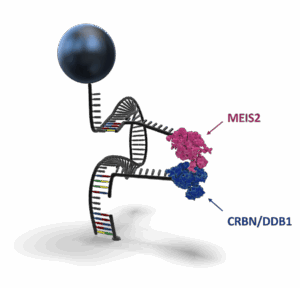
Figure 1: Schematic showing how the test proteins are attached to the nucleotide scaffold and paramagnetic nanobead within Depixus MAGNA One. Many thousands of these structures are precisely arrayed within a flow cell that is loaded into the instrument.
Analysis of single molecule traces revealed a stable interaction between CRBN/DDB1 and MEIS2 (figure 2) which could be broken and reset by applying magnetic force to the beads (sharp spikes).
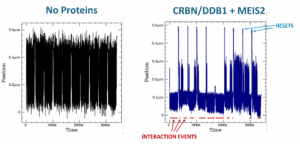 Figure 2: Single molecule data traces from Depixus MAGNA One showing the no-protein control (left) and individual interaction events between CRBN/DDB1 and MEIS2 (right). Interaction events are detected by a marked decrease in the amplitude of vertical bead movement, denoted by red bars. The trace from a single bead is shown here, but thousands of interactions can be studied in parallel.
Addition of CC885 inhibited the interaction between CRBN/DDB1 and MEIS2 in a dose-dependent manner (figure 3).
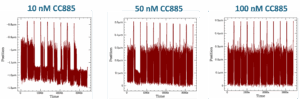
Figure 3: Single molecule data traces from Depixus MAGNA One showing how CC885 inhibits the interaction between CRBN/DDB1 and MEIS2 at three different concentrations of drug (10 nM, 50nM and 100 nM).
Whether you’re working with molecular glues, PROTACs, or other PPI-modulating drugs, Depixus MAGNA One enables real-time, label-free, non-destructive analysis of thousands of individual protein-protein interactions in parallel.
Download our app note to learn more about using Depixus MAGNA One to study molecular glues.
Book a call with one of our team to discover how Depixus MAGNA One can accelerate your molecular glue research.
References:
- Fischer ES, et al. Structure of the DDB1-CRBN E3 ubiquitin ligase in complex with thalidomide. Nature. 2014 Aug 7;512(7512):49-53. doi: 10.1038/nature13527
- Li L, et al. A Cereblon Modulator CC-885 Induces CRBN- and p97-Dependent PLK1 Degradation and Synergizes with Volasertib to Suppress Lung Cancer. Mol Ther Oncolytics. 2020 Jun 23;18:215-225. doi: 10.1016/j.omto.2020.06.013