
July 8, 2025
Comparing Depixus MAGNA One™ and SPR for analyzing protein-protein interactions
In the world of molecular biology and drug development, understanding how biomolecules interact is fundamental.
Whether you’re validating a drug target, confirming a mechanism of action, or exploring structure–activity relationships, accurate analysis of biomolecular interactions is key to making informed decisions.
This is particularly true for emerging or complex modalities such as drugs targeting protein–protein interactions and molecular glues, where traditional analytical methods can fall short.
A variety of techniques exist to study protein-protein interactions, each with their own strengths and limitations.
Here, we’ll compare one of the most common analytical methods for measuring protein-protein interactions, surface plasmon resonance (SPR), with our large-scale magnetic force spectroscopy (MFS) platform Depixus MAGNA One™.
We will highlight the key differences in the underlying technology and data outputs and explain how each can be used to support the development of new therapeutics.
Surface plasmon resonance
First developed in the 1990s, SPR has become a go-to method for measuring protein-protein interactions in both academic and industrial labs,1,3 with the best-known implementation being the Biacore™ platform.
How SPR Works
SPR detects interactions by measuring changes in the refractive index near a sensor surface.4 One molecule (ligand) is immobilized on a re-usable chip, and a solution containing its prospective binding partner (analyte) is flowed over the surface. As binding occurs, the change in mass near the sensor surface alters the refractive index, which is measured in real time (figure 1). The apparent change in mass can indicate that the molecules are bound to each other.
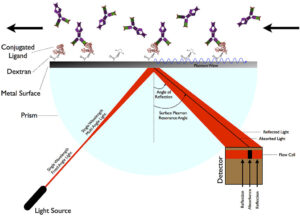
Figure 1: Diagram showing how SPR works (Sari Sabban via Wikimedia Commons, CC-BY-SA 3.0)
Applications of SPR in drug development
SPR can be used to study protein-protein interactions and drugs designed to target them, such as inhibitors or molecular glues. It can confirm target selectivity and specificity, and measure parameters such as binding affinity and kinetics.
The technique is typically applied in the initial stages of drug development, from initial screening and hit/target validation through to hit prioritization and lead optimization.
Strengths and weaknesses of SPR
SPR is an accessible, label-free method that offers high sensitivity and specificity, requiring only small sample volumes. It can simultaneously measure data on kinetics, affinity, and stoichiometry, and can deliver the high throughput required for large scale screening.
However, SPR can only produce low-resolution bulk average data, due to the inherent nature of the underlying technology. Furthermore, aspects of SPR assay development can be challenging, such as optimizing the chip surface chemistry to achieve the desired ligand immobilization and determining the best experimental conditions.5
SPR measurements may be susceptible to mass transport effects, where true measurement of the binding between test molecules is hampered by slow diffusion of the analyte to the chip surface.6 It is also important to account for bulk response artefacts generated by the behavior of molecules in solution.7
Finally, the detection limit of SPR depends on the mass ratio of the interacting molecules, which can make it challenging to detect interactions between low molecular weight compounds and much larger proteins.8
Depixus MAGNA One
Unlike SPR, which gathers average data from millions or billions of molecules, Depixus MAGNA One delivers single molecule insights at scale.
Based on magnetic force spectroscopy (MFS) and incorporating a number of key proprietary technological innovations, Depixus MAGNA One is a unique user-friendly platform for measuring thousands of individual protein-protein interactions in parallel.
How Depixus MAGNA One works
To measure protein-protein interactions, two target proteins or peptides are attached via oligonucleotide tags to a nucleotide scaffold. This is tethered to a precisely patterned flow cell surface at one end and a paramagnetic bead at the other. Up to 35,000 of these structures can be arrayed within a single flow cell chip.
A highly controllable magnet then applies force to the beads as required, while a visual tracking system provides precise data on the vertical position of each individual bead, translating into a dynamic real-time data stream from each individual interaction.
When little or no magnetic force is applied, the tethered proteins can interact and separate freely, providing valuable kinetic information about their interaction. Applying force reveals the strength of the interaction and insights into thermodynamic parameters. Ligands such as small molecules can then be introduced to study their effect on the strength and stability of the interaction.
Watch this animation to see how Depixus MAGNA One can be used to measure protein-protein interactions and explore the effect of small molecules:
By measuring tens of thousands of individual interactions in parallel over time, Depixus MAGNA One generates exceptionally detailed datasets.
This level of single-molecule resolution can reveal infrequent and short-lived binding events that may be biologically relevant. Such rare or transient interactions cannot be detected with SPR, as they would simply get lost within the averaged signals from millions of molecules.
Applications of Depixus MAGNA One in drug development
The data generated by Depixus MAGNA One reveals key biophysical and kinetic parameters about the interactions between proteins and the effect of small molecule ligands, as well as mechanistic insights into the nature and specificity of binding.
This can be used to inform hit-to-lead selection and interrogate mechanisms of action, accelerating the development of novel drugs that inhibit, stabilize or induce protein-protein interactions.
Strengths and weaknesses of Depixus MAGNA One
Depixus MAGNA One is a label-free method with high sensitivity and specificity, and single-molecule resolution, delivered in a user-friendly laboratory instrument.
It has small sample requirements and is non-destructive, so the same pairs of proteins can be interrogated across time through changing conditions or the addition of different ligands.
The single-molecule insights generated by Depixus MAGNA One make it particularly suitable for investigating rare, weak or transient interactions (such as protein-protein interactions), and for exploring heterogeneous populations of molecules. However, this also limits its throughput and utility for large-scale screening. This makes it best suited to target validation, hit-to-lead and lead optimization stages of drug discovery.
At-a-glance: Depixus MAGNA One versus SPR
| Depixus MAGNA One™ | SPR | |
|---|---|---|
| Underlying technology | Magnetic force spectroscopy (MFS) at scale. | Surface plasmon resonance (SPR). |
| Measuring principle | Direct real-time measurement of movements and forces as molecules interact. | Real-time changes in refractive index near a sensor surface as molecules interact. |
| Resolution | Single data streams from thousands of individual molecules. | Bulk ensemble data from millions or billions of molecules. |
| Sensitivity | Very high — can detect weak, transient and rare interactions. | High. |
| Parameters measured | Binding affinity, kinetics, and thermodynamic parameters in a single experiment. | Binding affinity, kinetics, thermodynamics. Target selectivity and specificity. |
| Good for… | Detailed analysis of binding mechanisms and kinetics, especially for weak, rare or transient interactions. | Rapid bulk measurement of target engagement and kinetic parameters for high-throughput screening, characterization & QC. |
Conclusion
Both SPR and Depixus MAGNA One are valuable tools for studying protein-protein interactions, but they’re built on fundamentally different technologies and each shine in different applications.
SPR is ideal for bulk measurements and rapid screening of homogeneous systems to support initial hit-to-lead decision-making in drug development.
Depixus MAGNA One enables detailed investigation of binding mechanisms and kinetics at the single-molecule level. It is especially effective for measuring rare, weak, or transient interactions and heterogeneous populations, providing deeper insights for lead selection and optimization.
Discover how Depixus MAGNA One can accelerate your drug development pipeline – download our product brochure or get in touch with the team to learn more.
Frequently asked questions about Depixus MAGNA One and SPR
Q: When is Depixus MAGNA One better than SPR for studying protein–protein interactions?
A: Depixus MAGNA One provides single-molecule resolution, making it ideal for studying weak, rare or transient protein–protein interactions that may be missed in the bulk average data produced by SPR.
Q: Can Depixus MAGNA One be used for large-scale screening?
A: By providing detailed insights into individual dynamic biomolecular interactions, Depixus MAGNA One is better suited for focused studies rather than high-throughput screening.
Q: What are the main limitations of SPR in drug discovery?
A: SPR can struggle with detecting low-affinity or transient interactions and produces bulk average data that may mask heterogeneity. Additionally, surface immobilization, non-specific binding and sample impurities can complicate assay development and data interpretation.
Q: How does the magnetic force spectroscopy (MFS) technology in Depixus MAGNA One differ from optical methods like SPR for analyzing biomolecular interactions?
A: Unlike optical methods such as SPR that measure bulk average responses, Depixus MAGNA One enables direct measurement of tens of thousands of individual dynamic responses, providing single-molecule resolution.
References:
- Karlsson R, Fält A. Experimental design for kinetic analysis of protein-protein interactions with surface plasmon resonance biosensors. J Immunol Methods. 1997 Jan 15;200(1-2):121-33. doi: 10.1016/s0022-1759(96)00195-0
- Nguyen HH, et al. Surface plasmon resonance: a versatile technique for biosensor applications. Sensors (Basel). 2015 May 5;15(5):10481-510. doi: 10.3390/s150510481
- Drescher DG, Drescher MJ. Protein Interaction Analysis by Surface Plasmon Resonance. Methods Mol Biol. 2023;2652:319-344. doi: 10.1007/978-1-0716-3147-8_19
- Motsa BB, Stahelin RV. A beginner’s guide to surface plasmon resonance. Biochem (Lond) 10 2023 March 45 (1): 18–22. doi: 10.1042/bio_2022_139
- Topor CV, Puiu M, Bala C. Strategies for Surface Design in Surface Plasmon Resonance (SPR) Sensing. Biosensors (Basel). 2023 Apr 7;13(4):465. doi: 10.3390/bios13040465
- Schuck P, Zhao H. The role of mass transport limitation and surface heterogeneity in the biophysical characterization of macromolecular binding processes by SPR biosensing. Methods Mol Biol. 2010;627:15-54. doi: 10.1007/978-1-60761-670-2_2
- Svirelis J, et al. Accurate Correction of the “Bulk Response” in Surface Plasmon Resonance Sensing Provides New Insights on Interactions Involving Lysozyme and Poly(ethylene glycol). ACS Sens. 2022 Apr 22;7(4):1175-1182. doi: 10.1021/acssensors.2c00273
- Sparks RP, Jenkins JL, Fratti R. Use of Surface Plasmon Resonance (SPR) to Determine Binding Affinities and Kinetic Parameters Between Components Important in Fusion Machinery. Methods Mol Biol. 2019;1860:199-210. doi: 10.1007/978-1-4939-8760-3_12