
October 2, 2025
Analyzing individual protein-protein interactions in real-time: a PD-1 / PD-L1 case study
Real-time single molecule data provides a deep understanding of protein-protein interactions (PPI) and can accelerate the development of drugs aimed at this emerging class of therapeutic targets. Our large-scale magnetic force spectroscopy (MFS) platform, Depixus MAGNA One™, delivers precise measurements of thousands of individual protein-protein interactions in parallel. These unique high-resolution data streams provide unprecedented insights to support drug development.
Here we demonstrate how Depixus MAGNA One can be used to study the interaction between PD-1 and PD-L1, a PPI that is an important cancer immunotherapy target.
What are PD-1 and PD-L1 and why is their interaction so important?
Programmed cell death protein 1 (PD-1) is an immune-checkpoint receptor expressed on activated T cells, B cells, and natural killer cells that has a role in down-regulating the immune system and promoting self-tolerance by suppressing T-cell inflammatory activity. Whilst this helps prevent autoimmune diseases, it can also stop the immune system from killing cancer cells.
PD-L1 is one of the primary ligands of PD-1 and is broadly expressed by many somatic cells mainly upon exposure to pro-inflammatory cytokines. When PD-L1 binds to PD-1, the interaction dampens T cell activation by transmitting an inhibitory signal that reduces the proliferation of antigen-specific T cells, while simultaneously reducing apoptosis in regulatory T cells.1
In cancer, tumor cells can exploit this pathway by overexpressing PD-L1, which leads to immune escape and tumor progression. Blocking the PD-1 / PD-L1 interaction to restore T cell function and enable an effective antitumoral immune response is therefore a major therapeutic goal in oncology.2 To date, this has primarily been achieved using monoclonal antibodies targeting PD-1 (e.g., Nivolumab, Pembrolizumab) or PD-L1 (e.g., Atezolizumab, Durvalumab). These immune checkpoint inhibitors have shown durable clinical responses in melanoma, non-small cell lung cancer, renal cell carcinoma, and other malignancies, although challenges remain, including resistance and immune-related adverse events.3
Using Depixus MAGNA One to study interactions between PD-1 and PD-L1 with single molecule resolution
To use Depixus MAGNA One to study the PD-1 / PD-L1 interaction, the two oligonucleotide tagged proteins were loaded into a flow cell cartridge containing an array of tethered paramagnetic bead-DNA scaffold complexes. This allowed the protein to attach to the scaffold by sequence complementarity to form structures as shown in Figure 1.
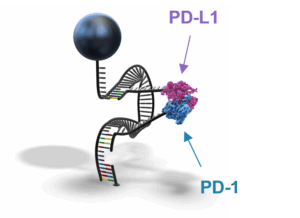
Figure 1. Schematic of a bead-DNA scaffold structure with attached PD-1 and PD-L1.
Depixus MAGNA One was then used to study individual PPI events by detecting the reduction in bead Brownian motion that occurs when the scaffold is constrained by the proteins being bound together. Figure 2 shows an example raw signal in which five interaction events can be seen over a five-minute period. This allows kinetic data to be extracted, not just for one protein pair but across thousands.
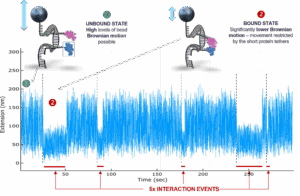
Figure 2. An example raw trace showing vertical bead position against time for a single pair of PD-1 / PD-L1 proteins. The bound and unbound states are clearly differentiated by the amplitude of vertical motion. Five interaction events (red bars) can be seen.
Next, we applied a controlled and ramped magnetic force to the bead to determine the force required to break the interactions (Figure 3).
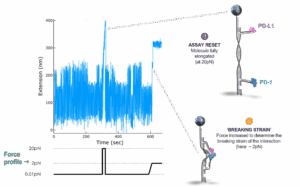
Figure 3. An example raw trace showing a ramped application of force at 600 seconds to determine the force required to break the interaction between a single pair of PD-1 / PD-L1 proteins. The spike at 300 seconds is due to a brief application of high force which is used periodically to separate any strong and stable interactions, resetting the system.
These types of experiments can be used to probe the underlying kinetic and thermodynamic parameters of protein-protein interactions, and to test the effect of drugs designed to either inhibit or stabilize them. The non-destructive nature of Depixus MAGNA One experiments means that the same protein pairs can be studied over time under various conditions – for example, in the presence of different test compounds or antibodies – generating valuable data to support hit-to-lead decision-making.
Want to see biology as it really happens? Talk to our team to learn more about Depixus MAGNA One: info@depixus.com
References:
- Tang Q, et al. The role of PD-1/PD-L1 and application of immune-checkpoint inhibitors in human cancers. Front Immunol. 2022 Sept 13;13: 964442. doi: 10.3389/fimmu.2022.964442
- Pardoll DM. The blockade of immune checkpoints in cancer immunotherapy. Nat Rev Cancer. 2012 Mar 22;12 (4):252-64. doi: 10.1038/nrc3239
- Ribas A, Wolchok JD. Cancer immunotherapy using checkpoint blockade. Science. 2018 Mar 23;359(6382):1350-55. doi: 10.1126/science.aar4060